
Destinations & itineraries · 03 Jun 2026 · 11 min read
Carbet Falls in Guadeloupe: everything to know before setting off on the hike
Carbet Falls are three waterfalls located in the town of Capesterre-Belle-Eau, in Basse-Terre, within the Guadeloupe National Park. In 2026, only the 2nd fall (110 m) is open under normal access from the visitor area: a 45 minute round trip walk, with an admission price of 6 EUR per adult. The 1st fall is temporarily […]
Carbet Falls are three waterfalls located in the town of Capesterre-Belle-Eau, in Basse-Terre, within the Guadeloupe National Park. In 2026, only the 2nd fall (110 m) is open under normal access from the visitor area: a 45 minute round trip walk, with an admission price of 6 EUR per adult. The 1st fall is temporarily closed following a rockslide that occurred in September 2025; the 3rd has been off limits since 2008 by municipal order. Before planning your outing, check the condition of the trails with the National Park to get the most up to date information.
Where are Carbet Falls and how do you get there?
Carbet Falls are located in Capesterre-Belle-Eau, in Basse-Terre, in the heart of the Guadeloupe National Park. From Pointe-a-Pitre airport, allow roughly 1h15 of driving via the RN1 national road and then the D4 from Saint-Sauveur. The D4 winds for 10 km from the national road up into the heart of the tropical forest.
By the D4 road from Pointe-a-Pitre (1h15)
From the RN1 near Capesterre-Belle-Eau or Saint-Sauveur, take the D4 heading toward “Chutes du Carbet”. The road climbs gradually through rainforest up to the visitor area. The journey from Pointe-a-Pitre takes about 1h15. If you come by bus, regular lines serve Capesterre-Belle-Eau from Pointe-a-Pitre, but the connection up to the visitor area requires a taxi or a local shuttle.
The visitor area: car park, opening hours and on-site services
The visitor area is open every day from 7:00am to 5:00pm. It has a car park, a souvenir shop, a picnic area and toilets. The GPS coordinates of the entrance: 16.04198 N / 61.63822 W. Tickets are purchased on site at the trailhead, not online. Bring cash or a bank card depending on what the ticket desk accepts.
What are the three Carbet Falls and which ones can you visit?
The three waterfalls are fed by the Grand Carbet river, which rises on the eastern flanks of La Soufriere and flows into the sea after about 13 km. This watercourse dates back 140,000 years. In 2026, only the 2nd fall is open under normal access: the 1st is closed following a rockslide, the 3rd has been off limits since 2008.
The 1st fall (115 m): the tallest - trail closed until further notice
The first Carbet fall is the tallest, with its 115 m over two tiers. Its trail has been closed since 22 September 2025, following a rockslide, “until further notice” according to the Guadeloupe National Park. The condition of the trail can change at any time: before you set off, check the National Park website or the RandoGuadeloupe site, “trail conditions” section, for up to date information. Do not venture onto a closed trail.
The 2nd fall (110 m): the most accessible, the most visited
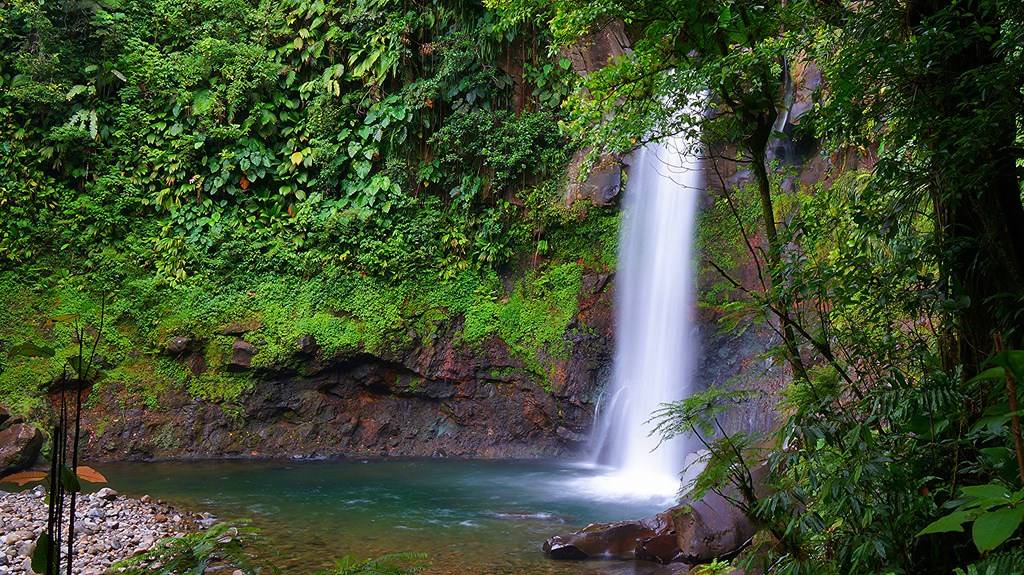
The second fall (110 m) is the only one open under normal access in 2026. The trail, developed and waymarked, takes 45 minutes round trip from the car park. The difficulty is easy to moderate, suitable for families with children in good physical condition. A developed viewpoint lets you admire the waterfall head on. Access to the lookout is partially possible for people with reduced mobility. Swimming beneath the fall is strictly prohibited for safety reasons: falling rocks and strong currents. If you wish to swim in the tropical forest, the Cascade aux Ecrevisses, about a 40 minute drive to the north, is an alternative with permitted water access.
The 3rd fall (20 m): off limits since 2008
The third Carbet fall, 20 m high, forms a circular basin. Its access has been off limits since 2008 by municipal order, following a rockslide. The trail that leads to it is outside the National Park boundary and is not maintained. You should not venture onto it.
How difficult are the trails and how much time should you allow?
The 2nd fall takes 45 minutes round trip from the car park, on a developed trail suited to families. The 1st fall, when it is accessible, requires 3 to 4 hours round trip and suits hikers used to wet tropical trails. The table below summarises the data for each fall.
| Fall | Height | Round trip time | Difficulty | Access 2026 |
|---|---|---|---|---|
| 1st fall | 115 m | 3 to 4 h | Difficult | Closed since 22/09/2025 (rockslide) |
| 2nd fall | 110 m | 45 min | Easy-moderate | Open |
| 3rd fall | 20 m | - | - | Off limits since 2008 (municipal order) |
Whichever fall you are aiming for, choose hiking boots or closed shoes with good grip: the trails are often wet and slippery under the forest canopy. Set off with water, a light rain jacket and insect repellent.
What are the prices for visiting Carbet Falls?
Access to the 2nd fall is paid: 6 EUR per adult, 4 EUR per child under 12, 14.50 EUR for the family rate (1 to 2 adults accompanied by 1 to 4 children under 12). These prices are in effect from 01/06/2025 to 31/05/2028 under the concession contract of the Guadeloupe National Park.
| Category | Price |
|---|---|
| Adult (12 and over) | 6.00 EUR |
| Child (under 12) | 4.00 EUR |
| Family rate (1-2 adults + 1-4 children under 12) | 14.50 EUR |
| Adult group (8 people and over) | 4.50 EUR/pers. |
| Annual pass for local residents | 16.50 EUR |
There is no mandatory online booking. Payment is made directly at the trailhead, with the concession operator Maranatha Tours. Entry to the 2nd fall is included in the price; there is no surcharge for the viewpoint.
What to see and do around Carbet Falls on the same day?
Capesterre-Belle-Eau brings together several natural sites within less than 30 minutes of the falls, including the Grand Etang and the road toward La Soufriere. The town is the gateway to the National Park on the southern side from the Caribbean coast of Basse-Terre.
The Grand Etang: a high-altitude lake in the heart of the National Park (1h30 walk)
The Grand Etang is a high-altitude volcanic lake located in the National Park, a few kilometres from the falls. The walk around the lake takes about 1h30 on a waymarked trail, with easy difficulty. The site is little visited and offers an atmosphere of dense tropical forest, with the wildlife characteristic of the Park: ouassous (freshwater crayfish), the Guadeloupe woodpecker, and the endemic raccoon. The National Park records more than 200 bird species across its entire area.
La Soufriere: the active volcano of Basse-Terre (35 min from the falls)
La Soufriere, an active volcano peaking at 1,467 m, is about 35 minutes from Carbet Falls by car. Combining the two sites in one day is feasible if you set off early in the morning. To prepare for the climb up the volcano, read our article on climbing La Soufriere in Guadeloupe.
The wildlife and flora of the rainforest: what you can spot along the way
The trail to the 2nd fall crosses a remarkable rainforest. Along the way, you will come across balisiers (Heliconia caribaea) with their red and yellow flowers, white gum trees that can exceed 35 m in height, tree ferns and wild orchids. The Grand Carbet river that runs alongside the trail is home to ouassous, those freshwater crayfish endemic to the French Antilles. The Guadeloupe woodpecker and the raccoon, two endemic animal species, regularly frequent the forest edge.
When is the best time to visit Carbet Falls?
The dry season (December to May, the Guadeloupean “Careme”) offers the best conditions for visiting Carbet Falls: passable trails, stable weather and a flow strong enough for the falls to be spectacular. In the rainy season (June to November), the trails become very slippery and showers are frequent. Set off early in the morning, before 9am, to avoid low mist and the crowds of groups in the middle of the morning. The falls are accessible from opening time at 7:00am.
How can you enjoy Carbet Falls from a catamaran cruise?
From the Bas-du-Fort anchorage (Pointe-a-Pitre marina), reaching Capesterre-Belle-Eau in 1h15 of driving lets you combine a day hiking to the falls with a catamaran cruise in the Caribbean. It is the must-do nature excursion for sailors anchoring in Guadeloupe.
What few visitors know: from the sea, off the eastern coast of Basse-Terre, the Grand Carbet river and the hills it cascades down are visible from the cockpit. It is precisely this sight seen from the sea that is said to have led Christopher Columbus to land at Capesterre in November 1493, during his second voyage. The falls, fed by a 140,000 year old watershed, can be glimpsed in the distance from the forest heights on the sailors’ horizon.
A typical day from a catamaran: in the morning, quiet sailing or anchoring in the Pointe-a-Pitre bay; departure by car around 8:00am from Bas-du-Fort; arrival at the falls’ visitor area around 9:15am; the climb to the 2nd fall and return to the car park before 11am; lunch in Capesterre-Belle-Eau or a picnic at the visitor area; return to the catamaran in the mid-afternoon to enjoy the end of the day at sea.
For sailors who wish to discover Guadeloupe in a way other than a rental charter, the catamaran cruises in the Caribbean with Sailoe include programmes that build in this type of shore excursion. More information on our Caribbean page.
FAQ - Frequently asked questions about Carbet Falls in Guadeloupe
How do you get to Carbet Falls without a car?
Regular buses connect Pointe-a-Pitre to Capesterre-Belle-Eau, but the last stretch from the town up to the visitor area is not served by the regular lines. A taxi or a local shuttle from Capesterre-Belle-Eau is needed for the 10 km of the D4 up to the car park. In high tourist season, some shuttle operators offer transfers from the main bases in Pointe-a-Pitre. Check availability with the local tourist office before you set off.
Can you swim beneath Carbet Falls?
No. Swimming is strictly prohibited beneath Carbet Falls for safety reasons: the risk of falling rocks and unpredictable currents at the foot of the waterfalls. This prohibition is signposted on site by the National Park. If you wish to swim in the forest, the Cascade aux Ecrevisses (accessible without a paid entry) is the recommended alternative, about a 40 minute drive to the north, on the Route de la Traversee.
Is the 1st Carbet fall open?
At the time of writing this article, the 1st Carbet fall has been closed since 22 September 2025, following a rockslide, “until further notice” according to the Guadeloupe National Park. The situation can change at any time. Before your visit, check the “trail conditions” page of the randoguadeloupe.gp site or the official National Park website to get up to date information.
Which Carbet fall is the easiest for a family with children?
The 2nd fall (110 m) is the only one recommended for families. Its developed trail takes 45 minutes round trip from the car park, with easy to moderate difficulty. Children in good physical condition can do it without difficulty, provided they wear closed shoes with good grip. A viewpoint offers a clear view of the waterfall. The 1st fall (3 to 4 h round trip, difficult) is reserved for experienced hikers.
Do you need to book in advance for Carbet Falls?
No, no booking is necessary or possible online. Entry tickets are bought directly on site at the visitor area, when the trail opens. The site draws crowds in high season (July-August and the Christmas holidays) but does not limit entries. Plan to arrive early (before 9am) to avoid the crowds and benefit from the best light for photographing the waterfall.
Can you combine Carbet Falls and La Soufriere in one day?
Yes, it is feasible by setting off very early in the morning. La Soufriere is about 35 minutes from the falls by car. A typical plan: visit the 2nd fall as soon as it opens at 7am (back at the car park around 9am), then drive to La Soufriere for the climb in the morning (back from the summit around 1-2pm). This day is demanding - bring good hiking boots, plenty of water and a portable meal. Do not attempt the 1st fall AND La Soufriere on the same day: the combined times would be excessive.
The 2nd Carbet fall remains one of the most accessible and most spectacular natural sites in Basse-Terre. Check the trail conditions before you set off and make the most of the day to explore the rainforest of the National Park. If you are sailing in the Caribbean, this excursion fits perfectly into a catamaran cruise departing from Guadeloupe.
Read also · Destinations & itineraries
Related articles
The Bay of Les Saintes, Seen From a Catamaran That Stays the Night
The Bay of Les Saintes, south of Guadeloupe between Terre-de-Haut and Terre-de-Bas, is usually visited in three hours, squeezed between two shuttle…
Where to Dive in the Seychelles on a Catamaran Cruise?
From a catamaran at anchor, scuba diving in the Seychelles is possible at dozens of sites around Mahe, Praslin and La Digue,…
Wingfoiling in the Seychelles: spots, winds and best season
The Seychelles offer an ideal window for wingfoiling from June to September, driven by the south-east trade winds that blow between 15…
Got a project in mind?
Our team is here to help
30 years of expertise, 5 physical bases, our own fleet. We reply within 24h.
Start the conversation