
Cruise preparation · 03 Jun 2026 · 11 min read
Catamaran Sailing Voyage: Everything You Need to Know Before Casting Off
Sailing a catamaran means choosing space, stability and a freedom that a monohull cannot offer. On a long voyage, the catamaran becomes a self-sufficient home capable of linking the most remote islands on the planet. Flat stability while underway, twin hulls, shallow draft to approach the coastline: this is the reference boat for crews who […]
Sailing a catamaran means choosing space, stability and a freedom that a monohull cannot offer. On a long voyage, the catamaran becomes a self-sufficient home capable of linking the most remote islands on the planet. Flat stability while underway, twin hulls, shallow draft to approach the coastline: this is the reference boat for crews who want to cover long distances without sacrificing comfort. This piece answers the essential questions for preparing a long catamaran passage.
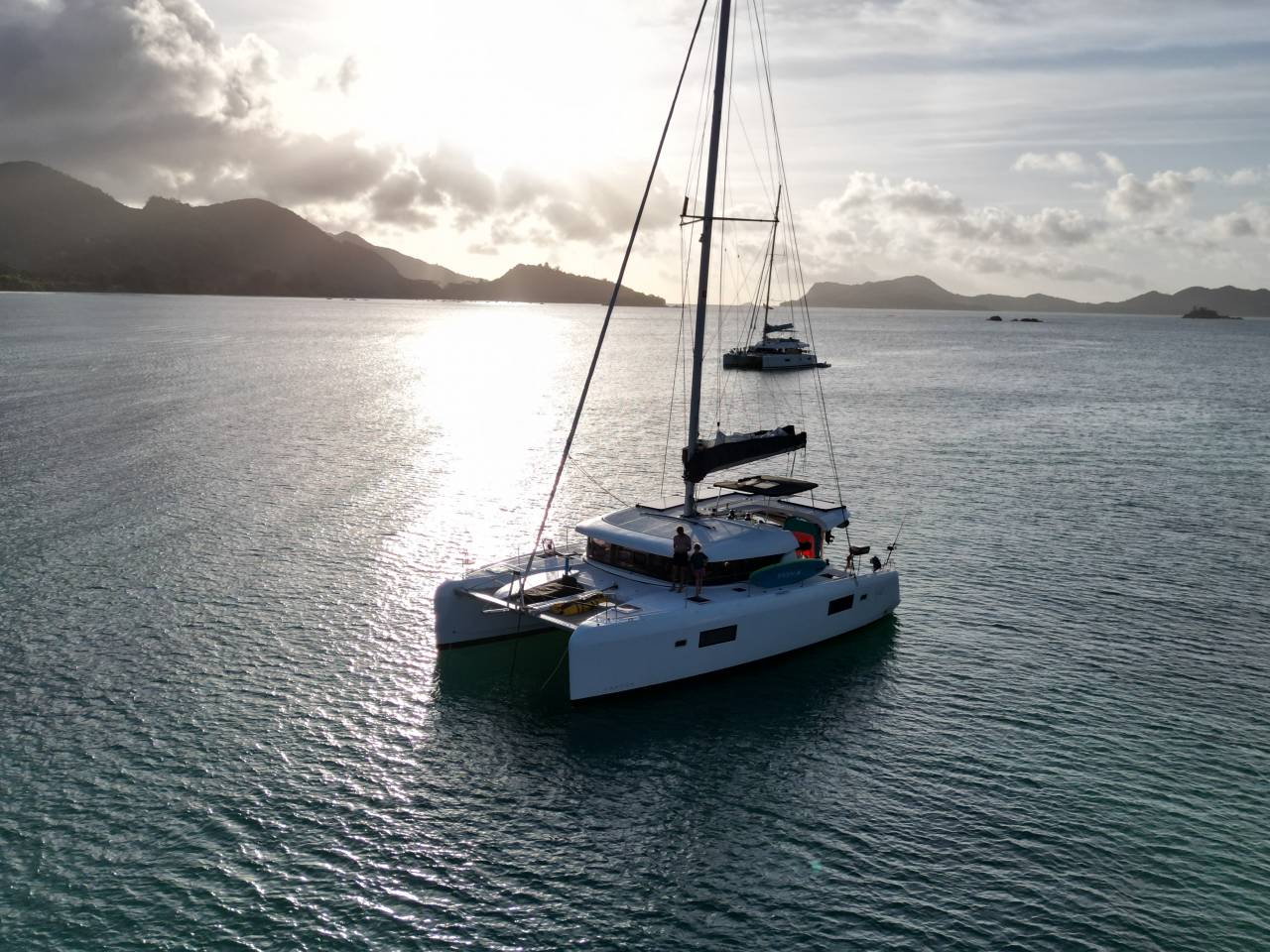
Why is a catamaran the best choice for a long voyage at sea?
The catamaran stands out for long-distance cruising for three main reasons: flat stability in all conditions, greater storage volumes than monohulls of equivalent size, and a reduced draft that allows anchoring in shallow waters. These three advantages radically change the quality of life aboard over several weeks at sea.
Stability and comfort: life aboard without heeling
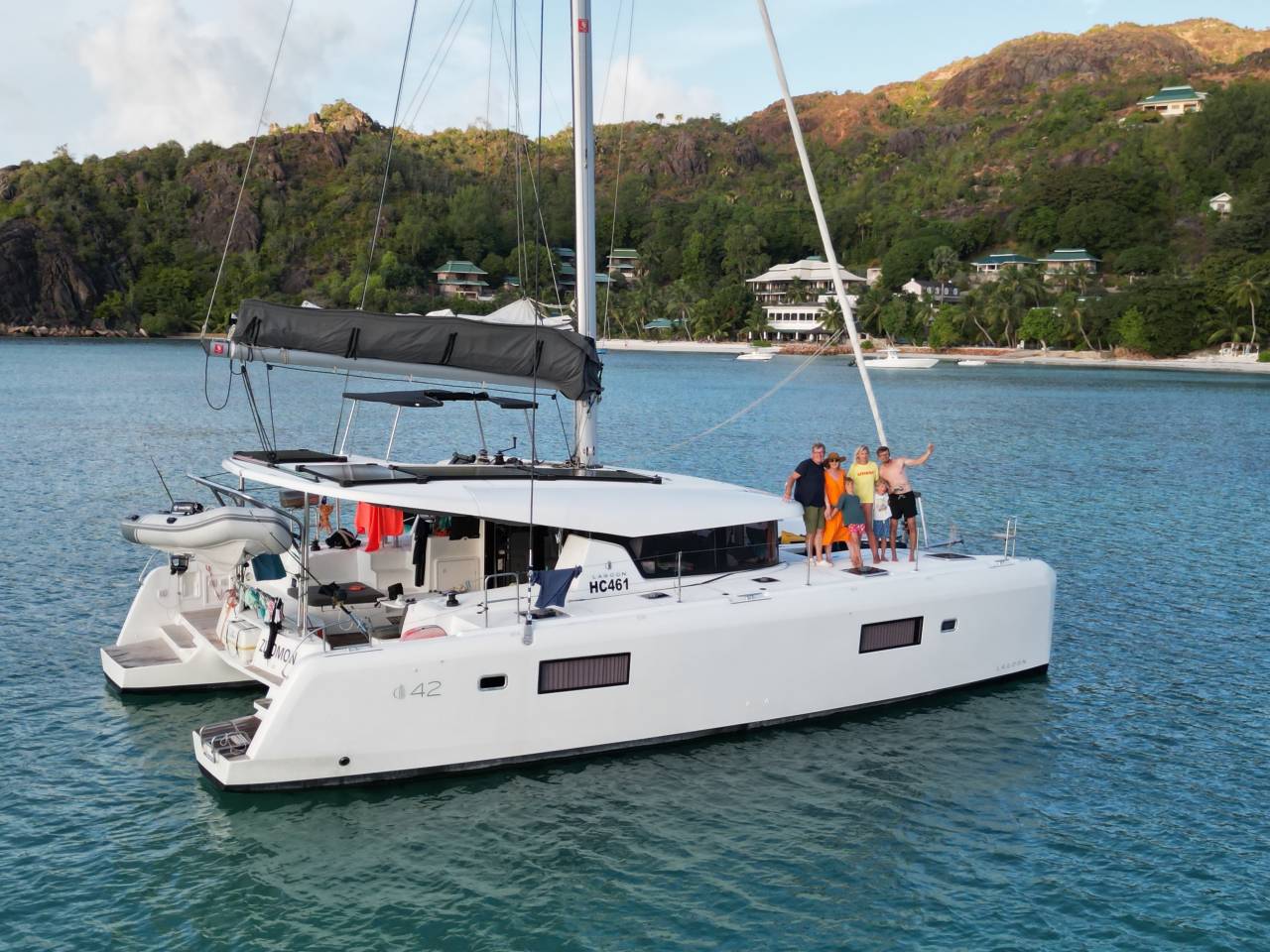
The catamaran’s twin hulls keep the boat flat regardless of the point of sail. The concrete result: cooking, sleeping and working aboard remain normal activities, even while underway. The living space of a 42-foot catamaran far exceeds that of a monohull of the same length. The covered cockpit, with its large shared table facing the sea, naturally becomes the heart of life for the crew: meals, watch-keeping, reading. It is this everyday quality of life that sets the catamaran apart on long passages.
Speed and sailing performance
A cruising catamaran reaches 7 to 10 knots in normal conditions, compared with 5 to 7 knots for a monohull of equivalent size. On an Atlantic crossing, this difference translates directly into days saved. The large sail area keeps a useful speed even in light winds, which reduces engine hours and therefore fuel consumption over long distances.
Draft and access to anchorages
The catamaran’s shallow draft opens access to coves and lagoons that deep-keel sailboats cannot reach. In the Seychelles, in Polynesia, in the Caribbean: these are precisely the most beautiful anchorages, found in shallow areas, sheltered from swell and from prying eyes. On a long cruise, the crew spends an average of 80% of the time at anchor rather than in a marina, which amplifies this advantage even further.
How do you plan the itinerary for a long catamaran voyage?
A long catamaran voyage is structured around offshore passages and stopovers, following the prevailing wind patterns: the trade winds on the Atlantic, the trades in the Pacific. The classic itinerary links the Mediterranean to the Caribbean via the Canaries and Cape Verde, before reaching the Pacific islands for crews who extend the journey.
The classic Atlantic route
The transatlantic route follows the North-East Atlantic trade winds, active from November to March with following winds of 15 to 25 knots. From the Canaries or Cape Verde, the crossing to the West Indies takes 10 to 11 days for a fast catamaran and 13 to 15 days for a heavier model. It is a physically demanding crossing but technically accessible to a well-prepared crew of two, thanks in particular to the autopilot that steers without interruption.
Stopovers in the Seychelles, Polynesia and the Caribbean
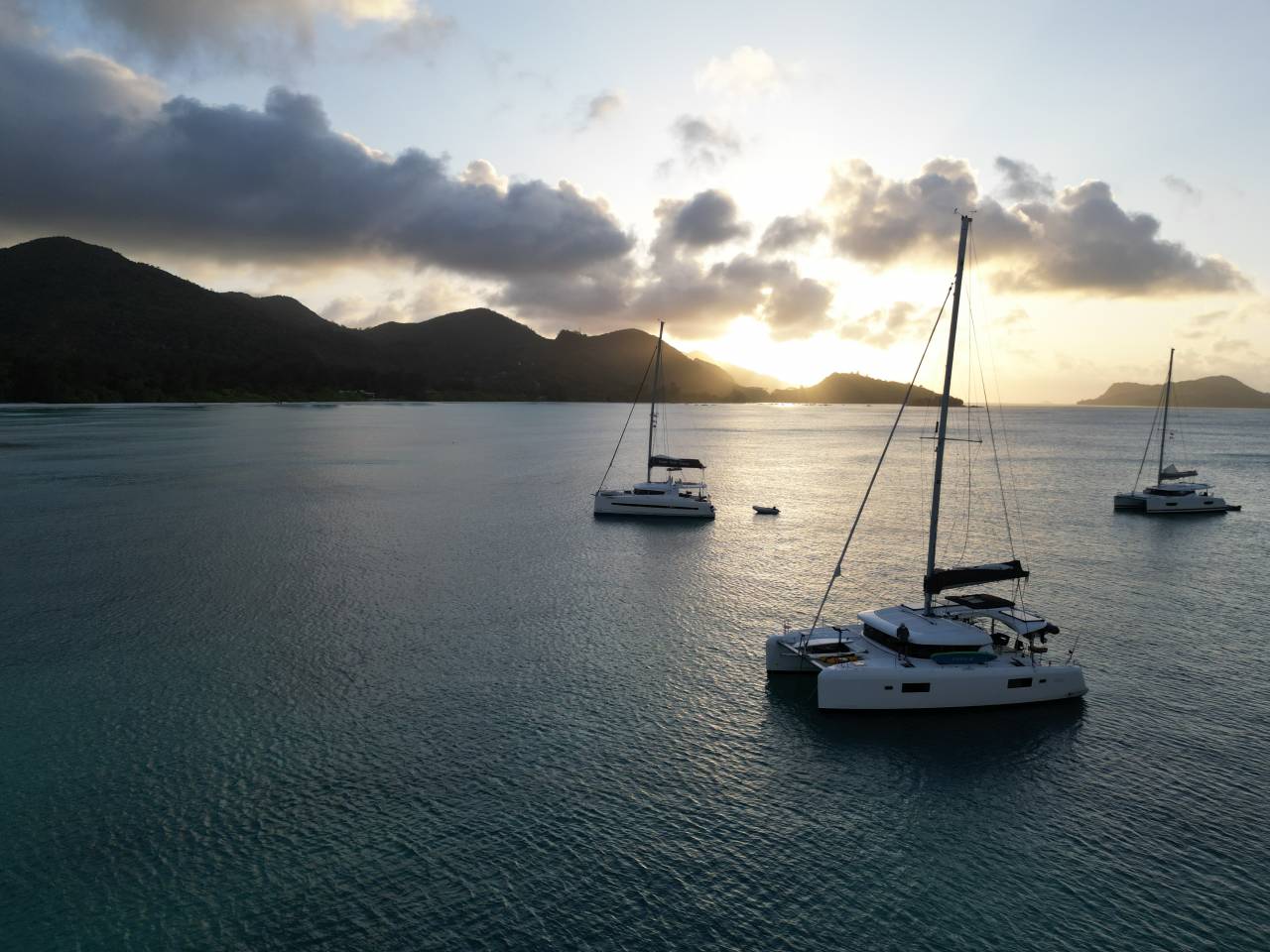
Arriving at Mahé from the north, with the silhouette of the pink granite rocks emerging from the Indian Ocean at dawn, seen from a catamaran’s cockpit after several days at sea: it is an image that sums up why people choose this kind of voyage. The lagoons of Polynesia are approached in the same way, at anchor over a white sand bottom. In Guadeloupe, the Bas-du-Fort bay offers an ideal arrival base to then reach the archipelagos of Les Saintes or Marie-Galante.
Sailoe offers crewed catamaran cruises in the Seychelles and the Caribbean, for those who wish to experience a long voyage without taking charge of the navigation. A formula that lets you discover these destinations as they appear from the sea, with no ownership commitment.
How much water and energy autonomy can you reach on a catamaran?
The autonomy of a cruising catamaran rests on three pillars: the watermaker for fresh water, the solar panels for electricity, and food storage sized for 2 to 6 weeks depending on the planned stopovers. Well equipped, a modern catamaran can stay several weeks without touching port.
Fresh water aboard: watermaker and reserves
Water needs vary with the crew and the climate: 40 to 60 litres per day for a frugal couple, 80 to 120 litres per day for a family of four in the tropics. A modern watermaker produces between 60 and 100 litres per hour depending on the model, for a consumption of about 1 amp per litre produced. Combined with bottled water reserves (a minimum of 2 litres per person per day), the well-equipped catamaran comfortably covers its needs even between two distant stopovers.
Solar energy and alternative sources
The roof of a 12 to 14 metre catamaran can hold 800 to 1,200 Wp of solar panels without major shading, which covers the majority of electrical needs in tropical sailing. As a complement, a hydrogenerator works while underway and produces energy from 5 to 6 knots of speed. The wind generator is less suited to downwind sailing in the trades, where the apparent wind drops, but remains effective at anchor in steady winds. The engines and alternators serve as a backup, not a main source.
What safety equipment is essential for a long crossing?
French regulations (Division 240) require specific equipment for offshore navigation. EPIRB beacon, serviced liferaft, 150 N lifejackets with tethers, fixed and portable VHF, AIS: this equipment is not optional for an ocean crossing. Ignoring it exposes the crew to real risks and engages the skipper’s responsibility.
Division 240: what the regulations say
Division 240 defines the obligations according to the navigation zone. For the high seas, the minimum mandatory equipment includes: an EPIRB beacon registered with the CROSS, mandatory beyond 60 miles from shelter and to be replaced every 10 years (between 300 and 600 euros); an offshore liferaft serviced every 3 years (800 to 2,500 euros to buy, or 150 to 300 euros per year to rent); 150 N minimum lifejackets with an ISO 12401 tether per person; a fixed DSC VHF mandatory from 6 miles off shelter, completed by a waterproof portable VHF in the offshore zone (beyond 60 miles); and three parachute flares with two floating smoke signals. This is not an indicative list: it is the minimum legal baseline.
Recommended navigation equipment
Beyond what the regulations require, some equipment has become a de facto standard for long-distance cruising. The autopilot frees the crew on long passages and allows real rest between watches. The AIS (Automatic Identification System) gives warning of approaching commercial vessels, particularly useful at night on busy routes. Satellite communication (Iridium or equivalent) keeps the link with land on passages without mobile coverage. Finally, a sail, engine and hull repair kit is essential far from ports: at sea, you are your own shipyard.
How do you live comfortably aboard over several weeks?
Life aboard on a long cruise is organised around the watches, meals taken together and a rhythm set by the weather. The catamaran makes everything easier: cooking on the level, generous living space, access to the cockpit and an open view over the horizon. But life at sea demands a daily organisation that the boat cannot replace.
Organising watches and sleep
On a passage of several days, the crew rotates in watches of 2 to 3 hours to maintain a permanent lookout. The autopilot takes over the steering and considerably reduces physical fatigue, but vigilance remains necessary: maritime traffic, weather changes, floating fishing gear. The hardest point to manage for inexperienced crews is fragmented sleep: it takes several days to adapt and accept sleeping in several stretches.
Provisions and cooking aboard
Food autonomy ranges from 2 to 6 weeks depending on the stopovers available along the route. The recommended calorie intake at sea for a moderate effort is 2,600 calories per day for an adult woman and 3,000 calories per day for an adult man. Fresh vegetables and fruit last 5 to 10 days at most in the tropics outside the refrigerator: the first days are the most comfortable, the last ones require some imagination. A freezer, a fridge and a few meals planned for heavy weather days round out the basic food equipment.
Which catamaran should you choose for a long voyage?
For a long voyage, a 40 to 50-foot catamaran offers the best compromise between living space, storage capacity and handling. This range can comfortably accommodate a crew of 4 to 8 people, while remaining manageable for two during manoeuvres in port and at anchor.
The criteria to assess at the time of choice: length (40 to 50 feet recommended), the number of independent cabins, the capacity of the water and fuel tanks, the navigation electronics and the robustness of the structure for offshore use. A new catamaran offers manufacturer warranties and the most recent equipment; a used catamaran opens access to larger models for an equivalent budget, at the cost of a thorough technical inspection before purchase.
Sailoe, exclusive Lagoon dealer in Brittany and Corsica, supports both new and used purchase projects. The Lagoon catamaran range covers the sizes and uses of long-distance cruising, from the 42-foot ideal for a couple to the 55-foot for a family or a group. For purchase projects, the team advises on the choice of model according to the navigation plan and assists with the procedures.
For those who do not wish to wait until they have their own boat, renting a Lagoon catamaran with a skipper in the Seychelles or in Guadeloupe is the best way to experience a first long voyage, to validate a life-at-sea project and to decide with full knowledge. A week in the Seychelles or the Caribbean from a Sailoe base is worth more than months of reading to know whether life aboard suits you.
FAQ - Your questions about catamaran voyages
Do you get seasick on a catamaran?
The catamaran significantly reduces seasickness compared with a monohull. Sailing on the level removes the heel, the main trigger of discomfort. In a rough sea, the twin hulls generate a different motion, a “pitching” in short waves, that some people feel more. On long passages in the trades (regular sea, steady following wind), the majority of crews have no problem. The uncomfortable zones remain coastlines with cross swell and headwinds.
Are catamarans safe for crossing the ocean?
Yes, the catamaran is recognised as a safe boat for ocean crossings. Its intrinsic buoyancy (two watertight hulls) and its theoretical inability to sink give it an advantage over the monohull in the event of flooding. The main risk specific to the catamaran is capsizing in a very heavy sea and extreme wind, a real but statistically rare risk on the classic offshore routes sailed with serious weather preparation. Transatlantic crossings by catamaran number in the thousands each year without incident.
What are the drawbacks of a catamaran compared with a monohull?
The catamaran has three main drawbacks. The beam (twice the width of an equivalent monohull) complicates access to certain marinas and increases mooring costs. Handling in port requires more practice, especially in strong wind. Finally, the behaviour in a very rough sea differs from a monohull and requires adaptation. On the financial side, the purchase and upkeep of a catamaran remain higher for an equivalent length.
How long does an Atlantic crossing by catamaran take?
The classic Cape Verde - West Indies crossing takes 10 to 11 days for a fast catamaran and 13 to 15 days for a heavier model, under north-east trade winds (November to March). The crossing is longer from the Canaries, averaging 14 to 18 days. These durations assume normal conditions; a depression or a flat calm can extend the passage by several days.
Do you need a licence to sail a catamaran on the high seas?
In France, offshore navigation requires the Offshore Licence (Permis Hauturier, or Coastal Licence with an offshore extension) for the skipper of the boat. This licence covers navigation more than 6 miles from shelter. For ocean crossings, complementary training of the CIN (Nautical Initiation Course) or SSB (long-distance radio) type is strongly recommended, even if it is not required by the texts. The rest of the crew has no regulatory qualification obligation.
How do you supply fresh water on a long voyage?
An onboard watermaker produces between 60 and 100 litres of fresh water per hour from seawater, which comfortably covers the crew’s needs in tropical sailing. As a complement, the catamaran’s main tanks (generally 400 to 800 litres depending on the model) allow water to be stored during stopovers. The basic principle: run the watermaker a few hours each day at anchor or while underway to keep the tanks full, and keep the bottles for breakdown or emergency situations.
Setting off to sea on a catamaran means choosing another way to travel: slow, self-sufficient, dictated by the winds and currents rather than by schedules. The technical preparation is serious and the logistics are real, but the result, an arrival at anchor in the Seychelles or in a Caribbean lagoon after a crossing at sea, belongs to another category of experiences. Contact the Sailoe team at charter@sailoe.com or on +33 2 97 84 61 61 to prepare your project, whether it is a first skippered charter or a purchase project.
Read also · Cruise preparation
Related articles
Catamaran Safety: Required Equipment and Good Reflexes
Catamaran safety rests on three pillars: a complete set of regulatory equipment matched to the navigation zone (France's Division 240), emergency procedures…
Sailing a Catamaran as a Beginner: What You Really Need to Know
A catamaran is more stable, more spacious and more accessible than a monohull for a beginner, provided you understand its particular handling…
Fresh water autonomy on a catamaran: tanks, watermaker and good habits on board
On a cruising catamaran, fresh water autonomy rests on three pillars: the capacity of the onboard tanks (300 to 960 litres depending…
Got a project in mind?
Our team is here to help
30 years of expertise, 5 physical bases, our own fleet. We reply within 24h.
Start the conversation