
Destinations & itineraries · 03 Jun 2026 · 8 min read
Cousteau Reserve Snorkeling: Everything You Need to Know Before You Dive In
The Cousteau Reserve brings together, around the Pigeon Islets at Bouillante (Basse-Terre), the richest seabeds in Guadeloupe: roughly 200 fish species, three species of sea turtle and some 400 hectares of protected habitats. The water stays between 26 and 29 °C all year long, and visibility often exceeds 20 metres in the dry season. Whether […]
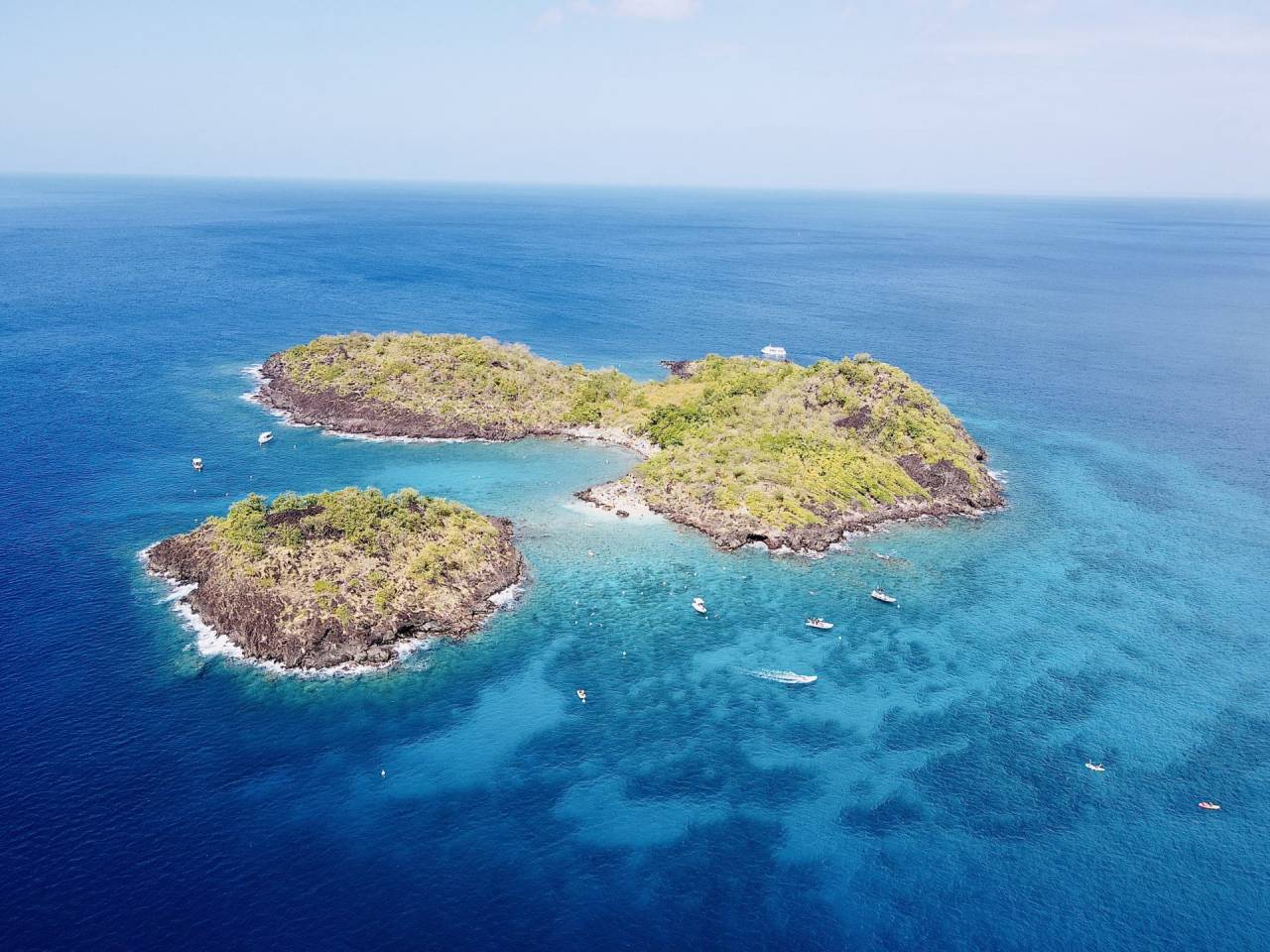
The Cousteau Reserve brings together, around the Pigeon Islets at Bouillante (Basse-Terre), the richest seabeds in Guadeloupe: roughly 200 fish species, three species of sea turtle and some 400 hectares of protected habitats. The water stays between 26 and 29 °C all year long, and visibility often exceeds 20 metres in the dry season. Whether you arrive from Malendure beach or from the deck of a catamaran anchored in the bay, the Pigeon Islets offer a snorkeling experience like no other in the Caribbean.
What is the Cousteau Reserve and why is it the best spot in Guadeloupe?
The Cousteau Reserve refers to the protected marine heart around the Pigeon Islets, off Malendure (Bouillante, Basse-Terre). Classified within the heart of the Guadeloupe National Park by decree of 3 June 2009, it is the richest snorkeling spot in the archipelago. “Cousteau Reserve” remains a popular common name rather than an official legal status: the site owes its fame to Jacques-Yves Cousteau’s dives in the 1950s and to the broadcast of his films, which introduced these seabeds to the general public.
The protection of the site by the National Park has made it possible to preserve a remarkably intact ecosystem. Across some 400 hectares of seabed, hard corals, gorgonians and giant sponges coexist with a dense pelagic fauna. The shallow depth of the coastal zones (2 to 8 metres depending on the zone) makes them accessible with fins, mask and snorkel, with no diving certification needed.
Which species can you spot while snorkeling at the Cousteau Reserve?
The reserve is home to roughly 200 fish species and three species of sea turtle. Green turtles (Chelonia mydas) and hawksbill turtles are regularly seen within a few metres of the surface. The water stays between 26 and 29 °C all year round, and visibility often exceeds 20 metres from January to May.
The most commonly encountered fish are the electric-coloured parrotfish, blue tang in tight schools, jacks and barracudas patrolling alone. Stingrays glide over the sandy bottom between the coral blocks. Lift your head out of the water near the islets and you will find brown pelicans and magnificent frigatebirds nesting just metres away.
The three snorkeling zones of the Pigeon Islets
Three distinct zones shape snorkeling around the Pigeon Islets.
The Swimming Pool: depth between 2 and 3 metres, with no notable current. The ideal zone for beginners and children. The sandy bottom dotted with coral lets you observe the most common species effortlessly.
The Aquarium: dense, multicoloured corals - orange gorgonians, brain corals, tube sponges - and a high concentration of reef fish. The depth is shallow here (2-5 metres), with optimal light in the morning.
The Coral Garden: seabeds down to 12 metres. This is where hawksbill turtles dive and barracudas roam. A bronze bust of Jacques-Yves Cousteau rests at a depth of 12 metres - visible while scuba diving, it remains out of reach for surface snorkeling. The zone has 2 mooring buoys for boaters.
How do you reach the Pigeon Islets for snorkeling?
Access to the Pigeon Islets is only by boat or kayak from Malendure beach at Bouillante, in a 5- to 10-minute crossing. Malendure beach is also open for free snorkeling in the seagrass beds on the north side, with no crossing required.
From Guadeloupe - Maryse Condé Airport (Les Abymes, Pointe-à-Pitre), allow roughly 45 to 55 minutes by road to reach Malendure: crossing Basse-Terre via the Route de la Traversée, then the N2 heading south along the leeward coast. The Malendure car park is limited in high season - arriving early in the morning avoids parking difficulties. Kayak access from the beach is possible for experienced paddlers; crossing the bay exposes you to motorboat traffic.
For sailors exploring Guadeloupe by catamaran, the Pigeon Islets are just a few minutes of finning away from an anchorage in Malendure bay. Sailoe offers catamaran cruises in the Caribbean with sailing weeks departing from Guadeloupe: the Cousteau Reserve is one of the natural stops on the itinerary.
What are the rules to follow when snorkeling in the Cousteau Reserve?
The reserve has been part of the heart of the Guadeloupe National Park since the decree of 3 June 2009. Anchoring is forbidden: only mooring on a designated buoy is allowed. Recreational fishing and any contact with the corals are prohibited throughout the zone.
The buoy system distinguishes two categories: white buoys for boaters (maximum depth 8 metres), fuchsia buoys reserved for professionals. Only one boat per buoy is allowed. Overnight mooring is forbidden. Motoring is prohibited in the channel between the two islets. When approaching turtles, a minimum distance of 5 metres is required - in practice, turtles approach motionless snorkelers of their own accord.
At the Aquarium, a single buoy is available for boaters. At the Coral Garden, two buoys take private boats. These figures translate concretely the usage pressure on the zone: in high season, the buoys are occupied by mid-morning.
What is the best season for snorkeling at the Cousteau Reserve?
The best period is from December to May, the local dry season, with visibility that often exceeds 25 metres and a calm sea. The water stays between 26 and 29 °C all year round, but the sea from July to November (the wet season) can be choppy, with visibility reduced by the rains and the upwelling of suspended matter.
The morning, between 8 a.m. and 11 a.m., offers a twofold advantage: the sea is calmer than in the afternoon and natural light enters the water vertically, making colours more vivid below the surface. This window coincides with the Caribbean charter season, which runs from December to April - so the catamaran sailing weeks naturally line up with the best period for snorkeling at the Cousteau Reserve.
How can you enjoy the Cousteau Reserve other than from the beach?
From a catamaran anchored in Malendure bay, the Cousteau Reserve is explored differently: you enter the water at the time of your choosing, with no group constraint or imposed schedule. The Pigeon Islets are reachable by swimming or finning from the anchorage, in just a few minutes.
This freedom changes the quality of the experience. Group snorkeling outings from Malendure concentrate many participants at the same time on the same zones. From a catamaran, you can choose the calmest hour - early in the morning or in late afternoon, when the group excursions have returned to port. The turtles and fish are then less disturbed and more approachable.
Sailoe offers organised catamaran cruises in Guadeloupe, with experienced crews who know the anchorage conditions and the most favourable windows for exploring the reserve. Snorkeling gear is on board: no equipment to rent or carry.
To go further into underwater Guadeloupe, our article on snorkeling in Guadeloupe covers the other spots of the archipelago and the conditions by destination.
FAQ - Cousteau Reserve Snorkeling
Where can I go snorkeling at the Cousteau Reserve?
Snorkeling at the Cousteau Reserve takes place around the Pigeon Islets, reachable by boat or kayak from Malendure beach at Bouillante, on the leeward coast of Basse-Terre. Three zones are accessible: the Swimming Pool (2-3 m, no current), the Aquarium (dense corals, reef fish) and the Coral Garden (down to 12 m, hawksbill turtles, barracudas). Malendure beach also allows free-access snorkeling in the coastal seagrass beds.
What is the most beautiful snorkeling spot in Guadeloupe?
The Cousteau Reserve, around the Pigeon Islets at Bouillante, is unanimously regarded as the richest snorkeling spot in Guadeloupe. It concentrates roughly 200 fish species in a zone protected since the decree of 3 June 2009 that brought the site into the heart of the National Park. Visibility often exceeds 25 metres in the dry season (December-May) and the water stays between 26 and 29 °C all year round.
Where can you snorkel with turtles in Guadeloupe?
Green turtles (Chelonia mydas) and hawksbill turtles are regularly seen at the Cousteau Reserve, particularly in the Coral Garden zone around the Pigeon Islets. The distance rule is a minimum of 5 metres. Turtles often approach motionless snorkelers of their own accord, especially in the morning before the group excursions arrive.
Do you need to know how to swim to snorkel at the Cousteau Reserve?
Knowing how to swim is necessary to snorkel at the Cousteau Reserve: the crossings are made by boat, but the activity itself involves moving along the surface for several minutes. The Swimming Pool zone, with 2 to 3 metres of depth and no current, is the most suitable for beginners and children. A buoyancy vest (offered by most local operators) allows non-swimmers to observe the seabed at the surface with a mask.
Can you reach the Cousteau Reserve by catamaran?
Yes, catamaran access is possible and common. Boaters must use the designated mooring buoys (anchoring is forbidden throughout the protected zone): white buoys for pleasure boats, at a maximum depth of 8 metres. One buoy is available on the Aquarium side and two on the Coral Garden side. Overnight mooring is forbidden. From the boat at its mooring, the Pigeon Islets are reachable directly by swimming or finning.
Read also · Destinations & itineraries
Related articles
The Bay of Les Saintes, Seen From a Catamaran That Stays the Night
The Bay of Les Saintes, south of Guadeloupe between Terre-de-Haut and Terre-de-Bas, is usually visited in three hours, squeezed between two shuttle…
Where to Dive in the Seychelles on a Catamaran Cruise?
From a catamaran at anchor, scuba diving in the Seychelles is possible at dozens of sites around Mahe, Praslin and La Digue,…
Wingfoiling in the Seychelles: spots, winds and best season
The Seychelles offer an ideal window for wingfoiling from June to September, driven by the south-east trade winds that blow between 15…
Got a project in mind?
Our team is here to help
30 years of expertise, 5 physical bases, our own fleet. We reply within 24h.
Start the conversation