
Destinations & itineraries · 03 Jun 2026 · 8 min read
Lion de Roccapina: hiking, beach and access from the sea
The Lion de Roccapina is a pink-granite rock formation carved by erosion, rising to 144 m in the municipality of Sartène, in southern Corsica. It overlooks two wild beaches that have been protected by the coastal conservancy since 1977 across a 501-hectare site. You reach it on foot from Roccapina beach via an unmarked, cairn-lined […]
The Lion de Roccapina is a pink-granite rock formation carved by erosion, rising to 144 m in the municipality of Sartène, in southern Corsica. It overlooks two wild beaches that have been protected by the coastal conservancy since 1977 across a 501-hectare site. You reach it on foot from Roccapina beach via an unmarked, cairn-lined trail, in roughly 2h round trip, or from the sea while anchored in the bay. From a catamaran, the lion’s silhouette stands out against the ridge as you approach - a bay entrance without equal in the Sartenais.
Where is the Lion de Roccapina and how do you reach it by car?
The Lion de Roccapina sits in the municipality of Sartène (southern Corsica), halfway between Sartène and Bonifacio, along the RT 40 road. It is one of the most recognisable natural landscapes in southern Corsica.
To get there by car, leave the RT 40 near the Coralli inn and take the dirt track on the right. Around 3 km of track separates the main road from the beach. The track is passable by all vehicles if you drive slowly - except after heavy rain. A laid-out car park is located near the beach, with two spaces at either end. For those who would rather not take the track, a viewpoint of the lion is accessible directly from the RT 40, on a promontory, without leaving the tarmac.
What is the hike to reach the Lion de Roccapina?
The classic hike from Roccapina beach takes around 2h round trip for an elevation gain of 180 to 200 m, on an unmarked but visible trail lined with cairns. The level is easy to moderate, suitable for families.
The short route covers 4.5 to 5 km round trip. The trail climbs towards the ridge across the maquis scrubland - juniper, cistus, myrtle - with no real shade: bring water and sun protection, especially in summer. At the top, the Genoese tower of Roccapina dominates the bay. Listed in the inventory of Historic Monuments since 29 July 1994 and first planned back in 1573, it was built in the early 17th century to watch over the coast. The panorama from around the tower stretches across the two beaches of Roccapina and Erbaju.
The trail is not officially waymarked - downloading a GPS track in advance is recommended. The cairns guide the climb but can be hard to spot when the site is busy.
Loop or round trip: which option should you choose?
Two options are available to hikers. The round trip from Roccapina beach (2h, 4.5 to 5 km, 180-200 m of gain) is the logical choice for families and beginners: direct, quick, with no risk of getting lost on the way back. The loop that takes in Erbaju beach - wilder and less frequented - is for confident walkers and offers varied views over the two coves. Choose according to the time available and the level of your group.
What is the legend of the Lion de Roccapina?
The legend tells that, in the time of the Saracens, a lord of great courage lived on this promontory. The Barbary corsairs had nicknamed him “the Lion of Roccapina”. Having fallen in love with a young woman he could not marry, he called upon death and was turned to stone in the shape of the lion, facing the sea for all eternity.
The rock formation itself is the result of a natural phenomenon known as “I Taffoni”: the crystallisation of salt, combined with wind, sea spray and rain, sculpts the granite over millennia until it takes on organic shapes. The highest point of the ridge reaches 144 m. The silhouette of the lying lion, its head turned towards the open sea, is visible from the sea as well as from the road - two readings of the same rock, two radically different experiences.
Corsican popular culture has immortalised this place in a traditional song: “U Liò di Roccapina / Hà dettu à l’Omu di Cagna / Tù mi vardi la marina / Eu ti vardu la muntagna” (The Lion of Roccapina / Said to the Man of Cagna / You watch over the sea / I watch over the mountain). A nod to the other iconic rock formation of the Sartenais, visible from the ridge on a clear day.
Roccapina beach: what should you know before you come?
Roccapina beach is a cove of white sand and turquoise waters, protected by the coastal conservancy since 1977 across a classified 501-hectare site. It is wild, with no commercial infrastructure whatsoever, and must be reached either by the track or from the sea.
The coastal conservancy describes Roccapina as “one of the most iconic places in Corsica: a cove of pale sand and turquoise waters, dominated by a rocky ridge on which sits, like a sphinx, this granite lion whose gaze has been turned towards the open sea for millennia.” North of the Cala di Roccapina lies Erbaju beach, larger and wilder, linked by the hiking loop.
The area is subject to enhanced natural protection: a 21-hectare ZNIEFF (second generation) covers the “Dune and wetland at the head of the Cala di Roccapina”, linked to the Vangone stream. The protected dune flora includes the sand catchfly, the purple spurge, the Corsican cudweed and the Nurra serapias. Ganivelles - chestnut-wood fences - have protected the dunes since the 1980s.
The site rules are strict: wild camping forbidden, fires forbidden, waste to be carried out, dogs on a lead. An interpretation centre, “A Casa di Roccapina” set up in the former roadman’s house, offers themed exhibitions and an audio guide to help you better understand the history and biodiversity of the site before or after your visit.
How can you see the Lion de Roccapina from the sea, anchored in a catamaran?
From a catamaran anchored in the bay of Roccapina, the lion’s silhouette stands out against the ridge as soon as you approach from the north. It is one of the most spectacular bay entrances in the Sartenais - and one of the passages that sailors cruising the Bouches de Bonifacio never miss.
The bay of Roccapina is reached from the north when coming from the gulf of Roccapina, or from the south when sailing up from the Bouches de Bonifacio. The Cala di Roccapina lies on the edge of the Bouches de Bonifacio nature reserve: the area calls for discretion and vigilance. Do not anchor on the posidonia seagrass beds - favour the sandy bottom, on the northern side of the cove, where the anchor holds well.
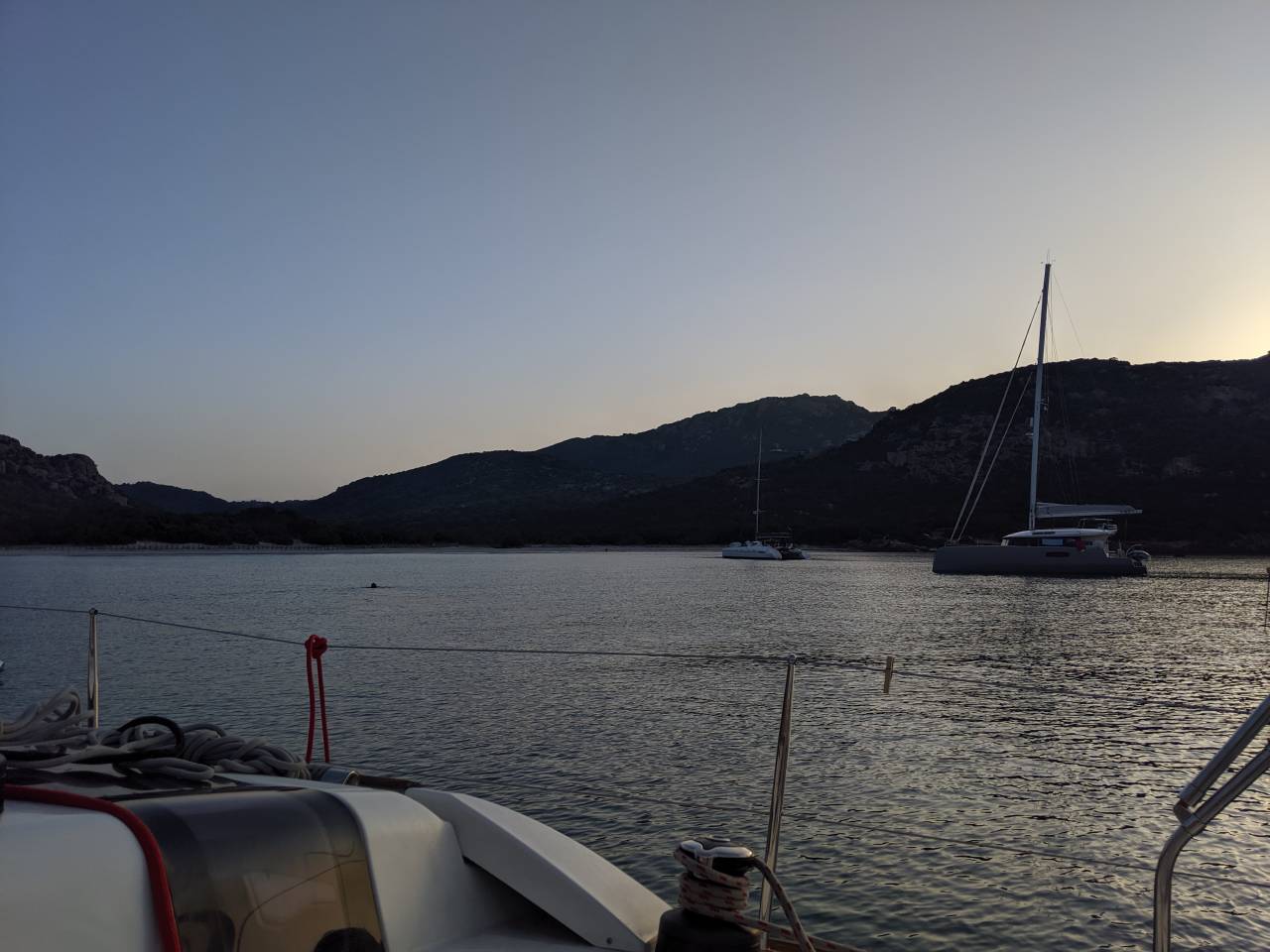
From the cockpit, the panorama is complete: the lion backlit at sunset, the Genoese tower on its ridge, the turquoise gradient of the cove tightening towards the white sand. Arriving by sea offers what the road cannot give - the perception of the whole site, cliffs, ridge and beach, in a single glance.
From the anchorage, the dinghy lets you land directly on the beach. The hike up to the lion (2h round trip) follows on naturally from the landing. Snorkelling in the cove, over a sandy and rocky bottom, rounds out the day.
Sailoe offers catamaran cruises with a stop at Roccapina, departing from Bonifacio - discovering the bay from the deck is the experience our crews consistently recommend to anyone sailing the Bouches. For those who prefer to plan their itinerary freely, a catamaran charter departing from Bonifacio lets you include Roccapina in your own route. Our crewed Corsica cruise programmes regularly call at this anchorage.
FAQ - Frequently asked questions about the Lion de Roccapina
How do you reach the Lion de Roccapina by car?
From the RT 40, take the dirt track to the right of the Coralli inn. The track, around 3 km long, is passable by all vehicles if you drive slowly, except after heavy rain. A car park is laid out near the beach. The viewpoint of the lion from the road is accessible directly on the RT 40, on a promontory, without taking the track.
Is the hike to the Lion de Roccapina difficult?
No. The hike from the beach is rated easy to moderate, suitable for families. Allow around 2h round trip for 4.5 to 5 km and 180 to 200 m of elevation gain. The trail is not officially waymarked but remains visible and lined with cairns. A GPS track is recommended. Be aware: there is little shade along the route, so bring water and sun protection, especially in summer.
Is the Lion de Roccapina a protected site?
Yes. Roccapina is a classified site managed by the coastal conservancy since 1977 (501 hectares). Wild camping and fires are strictly forbidden. Waste must be carried out. The area also includes a 21-hectare ZNIEFF protecting the dunes and the wetland of the Cala di Roccapina. Dogs must be kept on a lead across the entire site.
Can you anchor a catamaran in the bay of Roccapina?
Yes. The bay of Roccapina offers a pleasant anchorage, preferably on the northern side of the cove, over a sandy bottom. The area lies on the edge of the Bouches de Bonifacio nature reserve: respect the posidonia protection zones and do not anchor on the seagrass beds. In high season the bay can get busy - arrive early or outside July and August to enjoy a peaceful anchorage.
Read also · Destinations & itineraries
Related articles
The Bay of Les Saintes, Seen From a Catamaran That Stays the Night
The Bay of Les Saintes, south of Guadeloupe between Terre-de-Haut and Terre-de-Bas, is usually visited in three hours, squeezed between two shuttle…
Where to Dive in the Seychelles on a Catamaran Cruise?
From a catamaran at anchor, scuba diving in the Seychelles is possible at dozens of sites around Mahe, Praslin and La Digue,…
Wingfoiling in the Seychelles: spots, winds and best season
The Seychelles offer an ideal window for wingfoiling from June to September, driven by the south-east trade winds that blow between 15…
Got a project in mind?
Our team is here to help
30 years of expertise, 5 physical bases, our own fleet. We reply within 24h.
Start the conversation