
Destinations & itineraries · 03 Jun 2026 · 10 min read
Curieuse Island in the Seychelles: the Aldabra giant tortoises seen from the anchorage
Curieuse Island, 1 km north of Praslin, is home to more than 300 Aldabra giant tortoises roaming semi-freely across its 3 km². A marine national park since 1979, it can be visited on a half-day trip from Anse Volbert, or directly from your catamaran’s anchorage at Baie Laraie. Its mangrove, unique among the inner Seychelles, […]
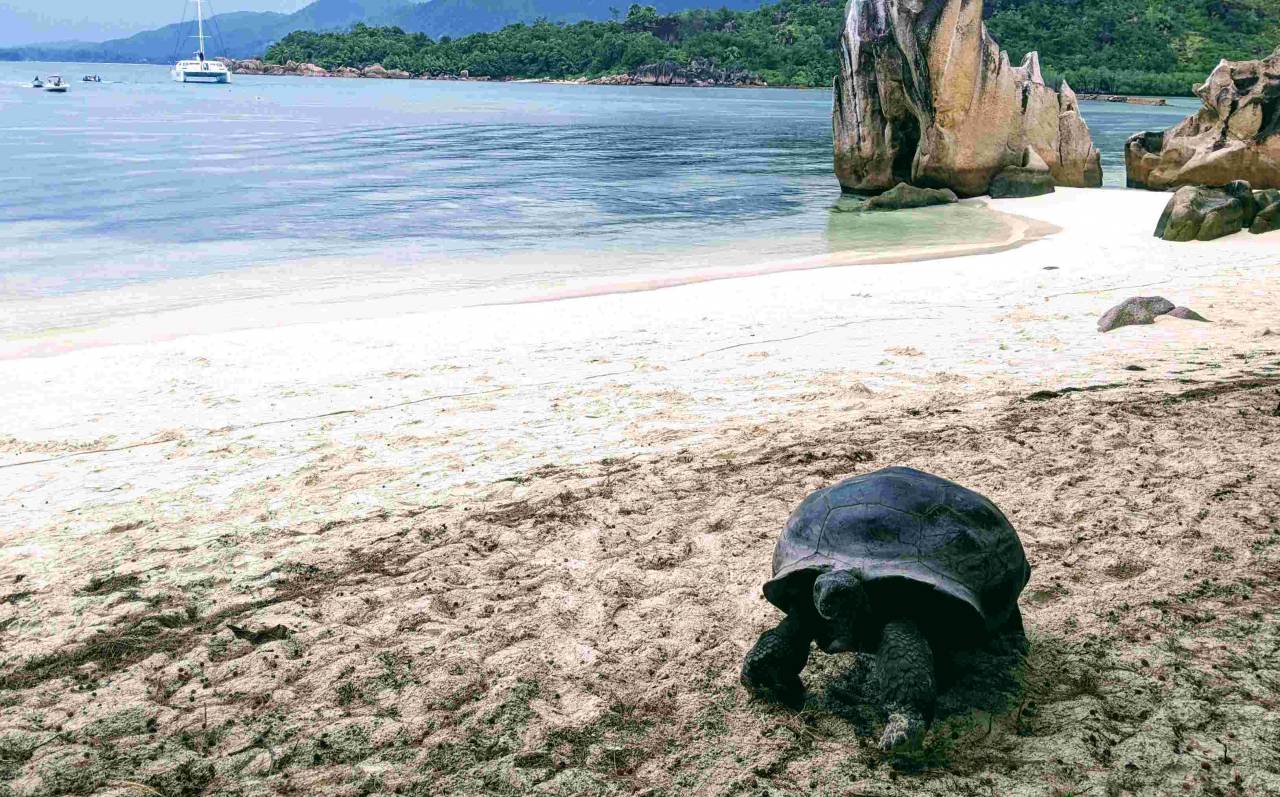
Curieuse Island, 1 km north of Praslin, is home to more than 300 Aldabra giant tortoises roaming semi-freely across its 3 km². A marine national park since 1979, it can be visited on a half-day trip from Anse Volbert, or directly from your catamaran’s anchorage at Baie Laraie. Its mangrove, unique among the inner Seychelles, its pink granite beaches and its leper-colony history make it an essential stop on any itinerary between Mahe and Praslin.
What is Curieuse Island and why is it dedicated to tortoises?
Curieuse Island is a Seychelles marine national park whose primary mission is the conservation of the Aldabra giant tortoises, reintroduced between 1978 and 1982. Its 3 km² of unspoilt nature and its exclusively maritime access make it one of the few places in the world where you can observe these century-old reptiles in an almost wild environment.
Where does the name “Curieuse” come from?
The name comes from the schooner La Curieuse, commanded in 1768 by the French explorer Marion du Fresne during an exploration expedition in the Indian Ocean. At the time the island was called Île Rouge, after the distinctive colour of its laterite soil, the vivid red earth you can still see while walking between Baie Laraie and Anse Saint-José. The name change followed the arrival of the French settlers, who renamed most of the archipelago’s islands after the first expeditions.
Why was the island off-limits for nearly a century?
From 1883 to 1965, Curieuse Island was home to a colonial leper colony. This forced isolation of more than 80 years had a paradoxical effect: the island’s flora and fauna escaped the massive destruction that hit the neighbouring islands, exploited for their coconut timber and marine resources. When the leper colony closed, the island was one of the least degraded in the inner Seychelles. It is this accidental preservation that made the giant tortoise reintroduction programme possible a few years later.
How many giant tortoises live on Curieuse Island?
More than 300 Aldabra giant tortoises (Aldabrachelys gigantea) live on Curieuse, descended from the reintroduction programme carried out between 1978 and 1982. They move around semi-freely across the whole island: on Baie Laraie beach when the boats arrive, along the mangrove trail, and across the patches of low vegetation on the north side.
What tortoise species is found on Curieuse Island?
The Aldabra giant tortoise, Aldabrachelys gigantea, is the largest land tortoise in the world. It can weigh up to 300 kg, measure 1.20 m long and live between 100 and 200 years. Its original natural habitat is the Aldabra Atoll, in the south-west of the Seychelles. The specimens present on Curieuse were introduced as part of the conservation programme led by the Seychelles authorities between 1978 and 1982, aimed at rebuilding a stable population in the inner islands.
Can you approach and touch the tortoises of Curieuse Island?
Yes. The tortoises move freely all over the island and approach visitors without fear, especially on Baie Laraie beach where the boats come ashore. Watching them at close range is possible and routine. Touching them is tolerated, but the park recommends doing so respectfully: stay calm, avoid sudden movements, do not feed the animals. The morning, before the first group day trips arrive, is when the tortoises are most active on the beach.
What is there to see and do on a visit to Curieuse Island?
A typical visit combines three moments: Baie Laraie beach with the tortoises on arrival, the 1.5 km mangrove trail to Anse Saint-José, and the doctor’s house converted into a biodiversity museum. The whole thing takes 3 to 3.5 hours, on foot, with no special equipment. The park is open from 9 am to 5 pm.
The mangrove trail: what do you discover between Baie Laraie and Anse Saint-José?
The 1.5 km trail links the arrival beach of Baie Laraie to Anse Saint-José beach, on the south side. It runs along a wooden boardwalk built over the mangrove, one of the densest and most diverse in the inner Seychelles: 8 species of mangrove tree have been recorded there. Along this path you come across Wright’s geckos, hawksbill turtles, sea snails and, if you pay attention, the Seychelles vasa parrot, a black parrot endemic to Curieuse and Praslin. The red laterite soil that borders the trail visually recalls the island’s former name. The wooden boardwalk remains usable even in the rainy season.
What does the doctor’s house on Curieuse Island hold?
The doctor’s house is a French colonial building from 1870, the former residence of the leper colony’s doctor. It has been converted into a biodiversity museum and visitor centre. It is one of the few architectural witnesses still standing from the colonial sanitary period in the Seychelles. The museum traces the island’s history, presents the local ecosystem and explains the tortoise reintroduction programme. The visit takes only 20 to 30 minutes but adds valuable context to discovering the island.
Which beaches on Curieuse Island are worth a stop?
Baie Laraie, on the north side, is the main arrival beach: pink granite, clear water, tortoises visible as soon as you step ashore. This is where the boats come in and where most visitors spend their time. Anse Saint-José, on the south side, is quieter and has a jetty. The waters of these two beaches are part of the marine national park, which guarantees good quality of the immediate underwater environment. Between the two, about 3,600 sea coconuts grow on the island, a species classed as endangered on the IUCN red list.
How do you reach Curieuse Island from Praslin or from your catamaran?
Curieuse Island is 15 to 20 minutes by boat from Anse Volbert, on the north-east coast of Praslin. By catamaran, the Baie Laraie anchorage allows you to arrive directly from the sea, without going through an excursion agency. The marine national park is open from 9 am to 5 pm. An entry fee of around twenty euros per person is collected at the entrance; it often includes a guide depending on the package, but the exact amount can vary.
One of the advantages of sailing on the catamaran cruises in the Seychelles offered from the Sailoe base in Mahe is being able to choose what time you arrive at Baie Laraie. Crews who anchor at first light often meet the tortoises alone on the beach, before the day’s first day trips arrive from Praslin. This freedom of timing, typical of catamaran sailing, transforms the visit: fewer people, more beautiful light, more active animals. To build a Seychelles catamaran itinerary that fits Curieuse in at your own pace, the Sailoe teams answer any quote request within 24 hours.
Can you combine Curieuse Island and Saint-Pierre Islet in a single day?
Yes. Saint-Pierre Islet, about 1.5 km from the tip of Praslin opposite Anse Volbert, is the most renowned snorkelling spot in the area. The combination of Curieuse in the morning and Saint-Pierre in the late morning is the classic excursion departing from Praslin, and fits perfectly into a half-day of catamaran sailing with no imposed schedule.
What do you see when snorkelling at Saint-Pierre Islet?
Saint-Pierre Islet is a shallow coral garden, reachable from the boat in less than 200 m of swimming. The waters are home to multicoloured tropical fish, rays and sea turtles. The depth stays under 10 m across almost the entire site, which makes it accessible to non-divers and children. It is regularly cited among the best snorkelling spots in the inner islands of the Seychelles. Sailors exploring the Praslin area often add Saint-Pierre to the same half-day as Curieuse, then continue towards the Fond Ferdinand reserve on Praslin or towards Cousin Island depending on their itinerary.
What is the best time to visit Curieuse Island?
The transition seasons, from March to May and from September to November, offer the best conditions: calm sea, maximum underwater visibility, moderate winds. These are the ideal periods for the Curieuse and Saint-Pierre combination. The dry season from June to August remains pleasant because the island is naturally sheltered north of Praslin. In the rainy season, from November to March, morning visits are preferable: showers most often occur in the afternoon. The mangrove trail remains usable thanks to the wooden boardwalk whatever the season.
Can you visit Curieuse in any season?
Yes. Curieuse marine national park is open all year round, 7 days a week. No period is technically off-limits. The dry season/wet season difference affects the comfort of the visit (wind, visibility, likelihood of showers) but not access to the island or the presence of the tortoises. For a catamaran cruise, the Sailoe crews adjust the itineraries according to local weather conditions, which makes it possible to visit Curieuse in the best windows even outside the transition seasons.
What to remember about Curieuse Island
Curieuse Island is one of the few places in the world where you can observe century-old giant tortoises roaming semi-freely, in a natural setting preserved by its very history. Its 3 km² pack in a mangrove with 8 species of mangrove tree, an intact colonial heritage and a pink granite beach reachable in 15 to 20 minutes from Praslin. By catamaran, the island fits into a Seychelles itinerary by arriving before the first day trips, which radically changes the visiting experience. The combination of Curieuse in the morning and snorkelling at Saint-Pierre Islet is one of the richest half-days in the inner islands, provided you arrive early.
Frequently asked questions about Curieuse Island and tortoises in the Seychelles
Where can you see tortoises in the Seychelles?
The giant tortoises are found mainly on Curieuse Island (marine national park, more than 300 individuals roaming semi-freely) and in the reserves of Praslin, Mahe, Cousin and La Digue. Curieuse Island remains the most accessible and most spectacular site for watching them at close range, with no barrier or enclosure.
Are there giant tortoises in the Seychelles?
Yes. The Seychelles are home to the largest populations of Aldabra giant tortoises (Aldabrachelys gigantea) outside their original atoll. The species can exceed 300 kg, reach 1.20 m in length and live between 100 and 200 years. Curieuse Island is home to more than 300 of them since the reintroduction programme carried out from 1978 to 1982.
What is the best time to go snorkelling in the Seychelles?
The transition seasons (March-May and September-November) offer the best conditions of visibility and calm. Saint-Pierre Islet, combined with the visit to Curieuse, is active all year round. The dry season (June-August) remains practicable despite a stronger trade wind.
Can you combine Curieuse Island and Saint-Pierre Islet in a half-day?
Yes. The combination of Curieuse (tortoises and mangrove trail, about 3 to 3.5 hours) and Saint-Pierre (snorkelling, 1 to 1.5 hours) is the classic excursion departing from Praslin. By catamaran, the two sites fit into a half-day with no fixed schedule.
What is the entry fee for Curieuse Island?
Access to Curieuse marine national park is subject to an entry fee of around twenty euros per person, guide included with certain packages. This amount can be built into the price of an organised excursion. The park is open every day from 9 am to 5 pm.
Read also · Destinations & itineraries
Related articles
The Bay of Les Saintes, Seen From a Catamaran That Stays the Night
The Bay of Les Saintes, south of Guadeloupe between Terre-de-Haut and Terre-de-Bas, is usually visited in three hours, squeezed between two shuttle…
Where to Dive in the Seychelles on a Catamaran Cruise?
From a catamaran at anchor, scuba diving in the Seychelles is possible at dozens of sites around Mahe, Praslin and La Digue,…
Wingfoiling in the Seychelles: spots, winds and best season
The Seychelles offer an ideal window for wingfoiling from June to September, driven by the south-east trade winds that blow between 15…
Got a project in mind?
Our team is here to help
30 years of expertise, 5 physical bases, our own fleet. We reply within 24h.
Start the conversation