
Destinations & itineraries · 03 Jun 2026 · 9 min read
Pigeon Islets in Guadeloupe: snorkelling, diving and anchoring at the heart of the Cousteau Reserve
The Pigeon Islets are two volcanic islets - Grand Îlet (7 ha) and Petit Îlet (1 ha) - located 1,100 metres off Malendure, in the town of Bouillante, on Basse-Terre. They form the heart of the Cousteau Reserve, one of the richest diving and snorkelling sites in the French Caribbean: more than 200 species of […]
The Pigeon Islets are two volcanic islets - Grand Îlet (7 ha) and Petit Îlet (1 ha) - located 1,100 metres off Malendure, in the town of Bouillante, on Basse-Terre. They form the heart of the Cousteau Reserve, one of the richest diving and snorkelling sites in the French Caribbean: more than 200 species of fish, sea turtles, intact coral reefs, and a bronze bust of Commander Cousteau submerged at -12 m. For a crew aboard a catamaran, it is the most memorable stop on the Guadeloupe route.
What are the Pigeon Islets and why are they famous?
The Pigeon Islets are two islets of volcanic origin - Grand Îlet (7 ha) and Petit Îlet (1 ha) - located 1,100 metres off Malendure, in the town of Bouillante, on Basse-Terre. The highest point of Grand Îlet reaches 35 metres. Their name does not come from the bird but from Anthoine Pigeon, a 17th-century landowner to whom these lands belonged. It was Commander Cousteau who made them world-famous by carrying out his first dives there in 1959 and by actively campaigning for their protection.
Today, the islets benefit from an exceptional cumulative protection: state-owned, managed by the National Forestry Office, classified as a ZNIEFF type I since 1996, integrated into the heart of the Guadeloupe National Park since 2009 (decree no. 2009-614 of 3 June 2009), and listed in the biosphere reserve recognised by UNESCO. The Cousteau Reserve, of which they form the heart, stretches over more than 400 hectares of seabed.
Where exactly are the Pigeon Islets located and how do you reach them by sea?
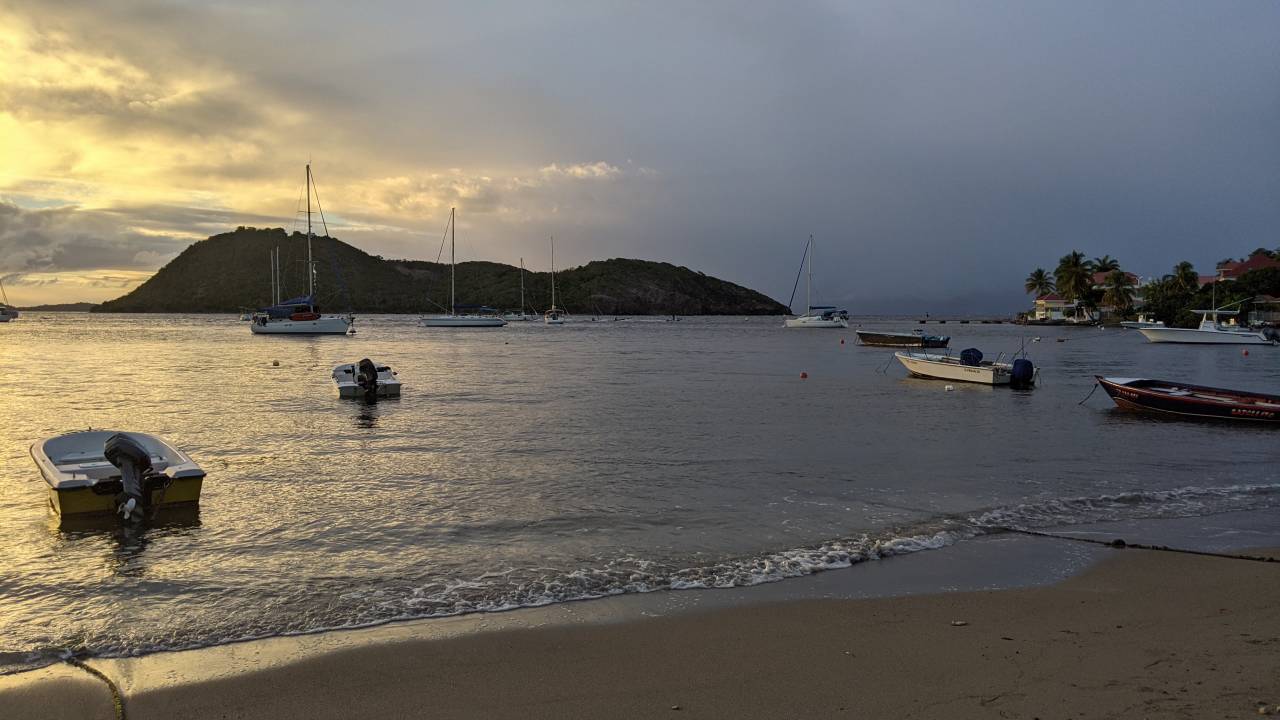
The Pigeon Islets are accessible only by sea from Malendure, in the town of Bouillante, on the leeward coast of Basse-Terre. From Malendure beach, allow about fifteen minutes by sea kayak or a few minutes by boat. There is no land access. Local diving clubs offer boat trips directly to the sites; independent snorkellers opt for the kayak, ideal early in the morning before the offshore swell picks up.
For sailors on a cruise, the Bas-du-Fort marina (Pointe-à-Pitre) is the natural starting point. From our Guadeloupe base, the classic route heads down to the leeward coast in two to three days of sailing depending on the trade winds, before stopping opposite the islets.
Can you anchor a catamaran at the Pigeon Islets?
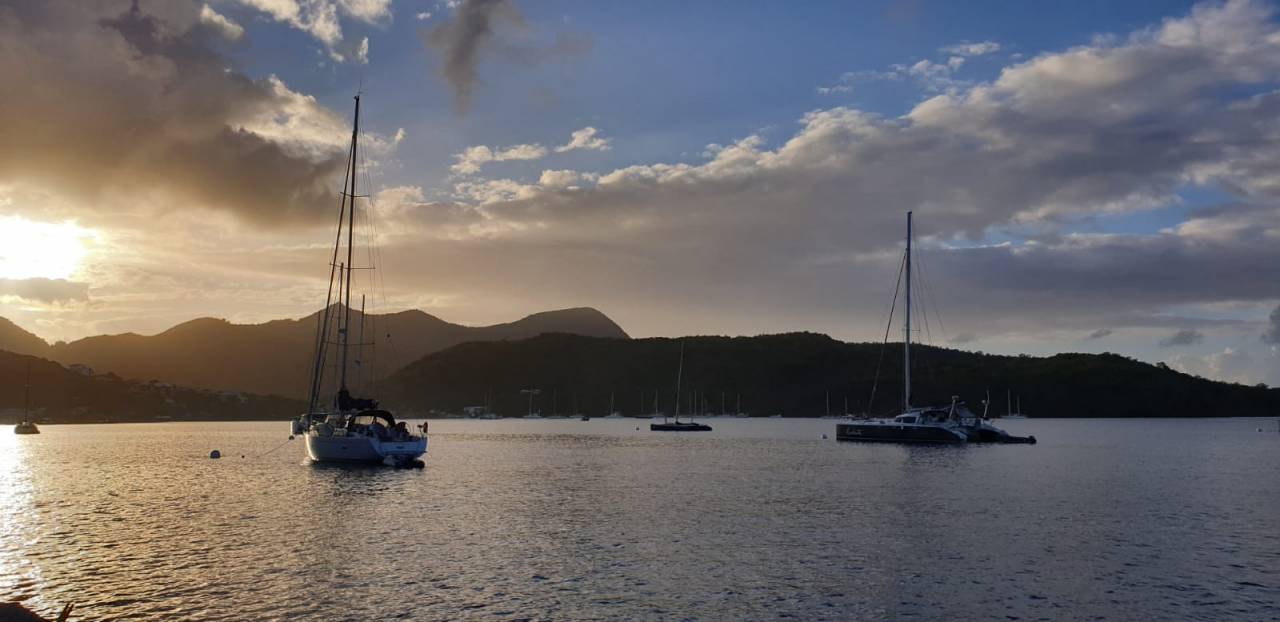
The answer is nuanced. White buoys reserved for boaters are moored to the north and south of the islets, but they accept only one boat at a time and are limited to vessels of 8 metres maximum. A standard charter catamaran (11 to 15 metres) therefore cannot use these regulatory buoys. The crew typically arrives by dinghy from a nearby anchorage - Malendure beach or an open area off Bouillante. This is precisely one of the advantages of a catamaran cruise: from the deck, you launch the tender, reach the sites within minutes, and return to your comfortable living space on board in the evening.
A few rules to keep in mind: free anchoring has been strictly prohibited since 2009 (fragile coral seabed), anchoring is limited to a maximum of 72 hours under the prefectoral order on navigation and anchoring, and overnight anchoring within the heart of the Park is prohibited. Motoring in the channel between the two islets is also prohibited.
What are the four snorkelling and diving sites not to be missed?
Around the Pigeon Islets, four sites concentrate most of the underwater life: the Coral Garden, La Piscine, the Aquarium and Pointe Barracuda - accessible from 0 to -35 m depending on your level. In the morning, before the first excursions arrive, the waters are remarkably clear: from the edge of the dinghy, you can make out the corals several metres deep.
The Coral Garden stretches along the eastern flank of the islets, with dense coral cover from -3 m depth. Parrotfish, angelfish and surgeonfish move in numbers among the corals. It is here, in the Coral Garden, that the bronze bust of Commander Cousteau rests, submerged at -12 m on 16 January 2004 - 80 kg of bronze paying tribute to the man who introduced these depths to the whole world. An advanced snorkelling site and a beginner diving site.
La Piscine is located in the area between Grand Îlet and Petit Îlet, with shallow waters sheltered from the swell. Ideal for beginners and snorkellers of all levels. You will encounter moray eels in their crevices and colourful tropical fish. Beware of fire coral: do not touch it, it causes burns.
The Aquarium runs along the northern flank of Grand Îlet on a submerged plateau, with a drop-off that descends gradually. A great diversity of species, accessible to beginners and intermediate divers.
Pointe Barracuda is reserved for experienced divers. The wall begins at -13 m and descends to -35 m, with gorgonian corals, large sponges and the big fish that give the site its name. A geological curiosity to note: hydrothermal springs (warm water rising from the underwater volcano) are present to the north of the islet.
What marine wildlife can you observe at the Pigeon Islets?
The Cousteau Reserve is home to more than 200 species of fish as well as sea turtles, rays and, with a bit of luck, dolphins as they pass through - a biodiversity among the richest in the French Caribbean. In the shallow waters, trumpetfish, blue surgeonfish and schools of barracuda are near-certain encounters. Sea turtles are present on a regular basis: observe them from at least 5 metres away, without feeding or chasing them.
For a crew aboard a catamaran, these encounters sometimes begin even before putting on the mask. The water of the reserve is transparent right from the surface, and from the bow net or the cockpit, it is not unusual to spot a turtle gliding along the hull at anchor.
On land, the islets are also home to a scientific curiosity: the endemic scorpion Oiclus cousteaui, a species first described in 2019, found only on Grand Îlet. The corals themselves deserve attention - dense reefs, gorgonians, sponges and fire coral make up a biotope that three decades of protection have managed to preserve.
What are the rules to follow to visit the Pigeon Islets without harming them?
The Pigeon Islets form the heart of a national park: the regulations are strict and breaches are punishable by fines. Here are the essential rules to know before anchoring or diving.
Anchoring and navigation:
- Free anchoring prohibited (coral seabeds protected since 2009)
- White buoys only, 1 boat of 8 m maximum per buoy
- Anchoring duration limited to 72 hours (prefectoral order on navigation and anchoring)
- Overnight anchoring prohibited in the heart of the national park
- Motoring prohibited in the channel between the two islets
- Only kayaks may land on Grand Îlet
At sea and underwater:
- Do not touch the corals or fixed wildlife (breach of the decree of 3 June 2009, article 3)
- Do not feed the fish or the sea turtles
- Fishing and spearfishing prohibited
- Use sunscreens free of oxybenzone and octinoxate (harmful to corals)
In the air and in photography:
- Drone overflight prohibited without prior authorisation from the Guadeloupe National Park
- Commercial filming and photography subject to prior authorisation
What is the best time to visit the Pigeon Islets?
The best time for the Pigeon Islets is the dry season, from December to April: calm sea on the leeward coast, optimal underwater visibility, no cyclone risk. It is also the high tourist season, which is felt in the crowds around the sites in the middle of the day. For calmer water and fewer people, favour a visit on a weekday, early in the morning.
The wet season (May to November) should not be ruled out for all that: the rains are more frequent, the cyclone risk exists (August to October), but many days offer splendid conditions and the sites are less busy. Underwater visibility can be reduced in the event of swell or recent heavy rain.
For crews on a cruise, December to April is the ideal window to combine this stop with favourable trade winds. From our base at Bas-du-Fort, the classic programme heads down towards Bouillante in two to three days of sailing, before heading back up towards Les Saintes or Marie-Galante. The details of the programme are available on our Guadeloupe catamaran cruise page.
For those who want to discover the Cousteau Reserve by diving from a catamaran, our page dedicated to snorkelling in Guadeloupe details the sites accessible across the entire leeward coast.
Frequently asked questions about the Pigeon Islets
How do you get to the Pigeon Islets?
The Pigeon Islets are accessible only by sea. Departure is from Malendure beach, in the town of Bouillante, on the leeward coast of Basse-Terre. Allow about fifteen minutes by sea kayak or a few minutes by boat from the shore. There is no land access.
Can you snorkel at the Pigeon Islets without being a certified diver?
Yes. Snorkelling can be done independently in La Piscine and the Aquarium, two shallow sites sheltered from the current. The Coral Garden is slightly more technical. No certification is required for snorkelling. For scuba diving, Pointe Barracuda (down to -35 m) is reserved for experienced divers.
How do you get to the Cousteau Reserve from Pointe-à-Pitre?
From Pointe-à-Pitre, reaching Bouillante by road takes about 45 to 50 km via the leeward coast. By catamaran from the Bas-du-Fort marina, allow two to three hours of sailing depending on the trade wind conditions. This is the classic itinerary of the Guadeloupe sailing route.
Can you land on the Pigeon Islets?
Only kayaks may land on Grand Îlet. Motorboats and sailing boats remain at anchor on regulatory buoys. No motorised landing is permitted on the islets under the regulations of the Guadeloupe National Park.
Where is the Cousteau bust at the Pigeon Islets?
The bronze bust of Commander Cousteau is submerged at -12 m depth in the Coral Garden, at the tip of Petit Îlet. It weighs 80 kg and was unveiled on 16 January 2004. It is one of the best-known underwater monuments in the French Caribbean.
Read also · Destinations & itineraries
Related articles
The Bay of Les Saintes, Seen From a Catamaran That Stays the Night
The Bay of Les Saintes, south of Guadeloupe between Terre-de-Haut and Terre-de-Bas, is usually visited in three hours, squeezed between two shuttle…
Where to Dive in the Seychelles on a Catamaran Cruise?
From a catamaran at anchor, scuba diving in the Seychelles is possible at dozens of sites around Mahe, Praslin and La Digue,…
Wingfoiling in the Seychelles: spots, winds and best season
The Seychelles offer an ideal window for wingfoiling from June to September, driven by the south-east trade winds that blow between 15…
Got a project in mind?
Our team is here to help
30 years of expertise, 5 physical bases, our own fleet. We reply within 24h.
Start the conversation