
Destinations & itineraries · 03 Jun 2026 · 9 min read
Fishing in the Strait of Bonifacio: the regulations to know from a catamaran
Recreational fishing is possible in the Strait of Bonifacio, but strictly governed by the regulations of the Nature Reserve (RNBB). From a catamaran, you can fish by line, by trolling or by handline in the permitted zones, provided you have completed your prior declaration with the OEC. Groupers and brown meagres are completely prohibited to […]
Recreational fishing is possible in the Strait of Bonifacio, but strictly governed by the regulations of the Nature Reserve (RNBB). From a catamaran, you can fish by line, by trolling or by handline in the permitted zones, provided you have completed your prior declaration with the OEC. Groupers and brown meagres are completely prohibited to catch.
The RNBB covers 79,460 hectares that are almost entirely marine (decree of 23 September 1999) and represents one of the best-preserved marine areas in the western Mediterranean. This exceptional richness, with rocky seabeds, Posidonia seagrass and crystal-clear waters, explains why the regulations here are more demanding than elsewhere in Corsica. Before lowering the rods from the catamaran, a few points are non-negotiable.
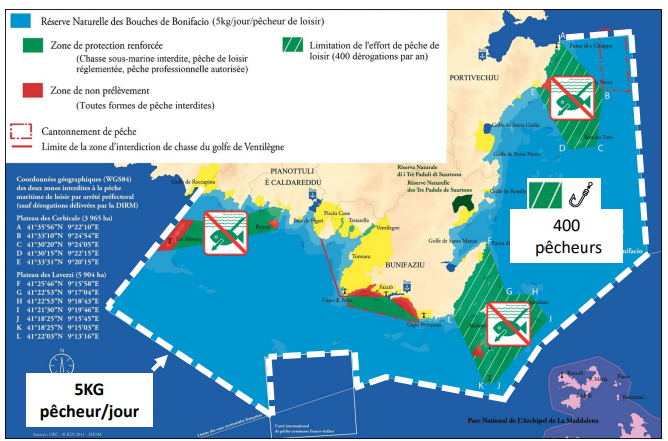
Is fishing allowed in the Strait of Bonifacio Nature Reserve?
Recreational fishing is allowed in certain zones of the RNBB, but prohibited in others. The reserve is divided into three levels of protection that precisely define what you can do from your catamaran.
The No-Take Zone (ZNP) covers about 1.5% of the reserve (and up to 4% when including the protected breeding areas). It includes the immediate surroundings of the Lavezzi and Cerbicali islands. In these zones, all fishing is prohibited, even from a boat at anchor. If you spend the night at anchor off Lavezzi, no line may be put in the water.
The Reinforced Protection Zone (ZPR) represents about 15.3% of the reserve. This is where casting, trolling and handline fishing are permitted as part of the OEC declaration. Spearfishing, however, is strictly prohibited here, whatever your experience or your equipment.
The Free Movement Zone (ZLE) covers the rest of the reserve. The standard national regulations apply here, with no specific declaration as for the ZPR, but always with the species bans that apply to the entire RNBB.
How do you register to fish in the RNBB in 2026?
To fish in the ZPR zones of the reserve, prior declaration with the Corsican Environment Office (OEC) is mandatory. It is the essential condition for being compliant during an inspection at sea.
The legal basis for this obligation is prefectural decree no. 2018-03-02-001 of 2 March 2018. Declarations for the 2026 season opened on 6 November 2025. The procedure is carried out exclusively in person at the OEC branch in Porto-Vecchio.
Location: U Centru building, route de Bastia, Porto-Vecchio (opposite the BUT store) Opening hours: Tuesday and Thursday, 9 am to 12 pm Contact: 04 95 72 30 31
The Catchmachine platform (catchmachine.fr/zone/5) lets you pre-fill your file online, but in-person validation remains mandatory, you cannot complete the process 100% online. The capacity within the ZPR of the Lavezzi-Cerbicali area is limited to 400 anglers at any one time. In high season, it is advisable to arrange this in advance.
Who must register?
Every recreational angler wishing to fish in the ZPR zones of the RNBB must register individually. The declaration cannot be shared across a catamaran crew: each person who puts a line in the water must have completed their own procedure. If three of you are fishing on board, three declarations are required.
Which species can you fish (and which are prohibited)?
The Strait of Bonifacio is subject to two national moratoriums that apply to the whole of the French Mediterranean. These bans are absolute and apply at sea, whatever the zone.
The grouper has been subject to a moratorium in the French Mediterranean since 1993 for spearfishing, extended to hook-and-line fishing in 2002. Five species are concerned (dusky grouper, golden grouper, grey grouper, goldblotch grouper, white grouper), to which is added the wreckfish, banned on the same date. This moratorium was renewed for 10 years at the end of 2023 by prefectural decree. The brown meagre has been banned from spearfishing and hook-and-line fishing since 2013, a moratorium also renewed for 10 years at the end of 2023. These two species are protected because they are indicators of ecosystem health, and their presence in the Strait is precisely one of the signs that the reserve is working.
The species accessible from a catamaran at anchor or drifting include sea bass, common dentex, barracuda, leerfish, bluefish, common pandora and cephalopods (cuttlefish, octopus, squid). Minimum catch sizes per species in the Mediterranean vary, so check with the Bonifacio harbour office or the mer.gouv.fr website before setting sail.
On seasonality: summer (July-August) favours catches of leerfish and barracuda, often in the evening and early night from the cockpit or the front balcony. Autumn is the best period for sea bass and cephalopods. The common dentex observes a biological rest period from mid-March to mid-April, a window to avoid for targeting this species.
The grouper, what do you do if you accidentally hook one?
If a grouper bites your hook, the rule is clear: immediate release, without unnecessary handling. Taking a grouper out of the water to photograph the catch is an offence, even with the intention of releasing it. The best approach is to bring the fish up to the surface as little as possible, to unhook it in the water if you can, and not to mention the catch on the voluntary declaration tools. OEC and Maritime Affairs officers carry out active inspections during the season.
Where can you fish from a catamaran at anchor in the Strait of Bonifacio?
One of the advantages of the catamaran is the variety of fishing spots: rear cockpit, front balcony, inflatable tender, you can fish from positions impossible on a monohull. The main question is knowing where to anchor in order to stay within the permitted zones.
| Technique | Recommended zone | Notes |
|---|---|---|
| Trolling (underway) | ZPR + ZLE | Prohibited within 300 m of the coast |
| Line at anchor | ZPR (Piantarella, Sperone coast) | Prohibited in ZNP even at anchor |
| Handline from the tender | ZPR, rocky seabeds | Effective for unintended groupers, release mandatory |
| Cephalopods (night) | ZLE, entrance of the gulf | Headlamp + light squid jigs |
| Spearfishing | PROHIBITED throughout the ZPR | Strict regulations |
The Lavezzi islands are a very popular anchorage destination, but an important reminder: as soon as you are at anchor within the Lavezzi ZNP, no fishing is possible. The Piantarella area, east of Bonifacio, and the Sperone coast offer access within the ZLE with a good variety of seabeds. The port of Bonifacio itself is generally closed to fishing in season, so check with the harbour office.
The official map of the RNBB zones is available from the OEC. Always carry it on board: officers inspect anglers at sea and the map is among the documents expected.
Quota, catch limit and marking: what the 2026 regulations say
In the ZPR zones, the quota is 5 kg of fish per angler per day. A particular rule applies when a single fish exceeds this threshold on its own: if your first fish weighs more than 5 kg, your fishing day is over.
Marking is mandatory: every fish kept in the ZPR must be marked by a notch in the lower caudal fin. This marking allows inspection officers to identify catches made in the reserve during checks in port.
The Catchmachine platform encourages voluntary declaration of catches after each outing. This record is not mandatory, but it contributes to the scientific data the OEC uses to manage the reserve. Inspections at sea and on return to port are carried out by OEC officers and Maritime Affairs, particularly during the months of July and August.
Fishing in the Strait of Bonifacio from a chartered catamaran: the essentials to prepare before setting sail
Preparing a fishing outing from a charter catamaran requires a little anticipation, but the process is straightforward once you know the steps.
Before departure:
- Register yourself (and each angler in the crew) with the OEC in Porto-Vecchio (Tuesday or Thursday, 9 am-12 pm, U Centru building)
- Download the official map of the RNBB zones
- Check the weather conditions: the tramontane wind can pick up quickly over the Strait
Equipment suited to the Strait: The seabeds of the Strait are rocky and varied. Favour light rods (7-21 g) for surface fishing, transparent soft lures of 2 to 5 cm for sea bass and barracuda, and natural-bait handlines for seabeds between 20 and 50 m. From the tender, you reach areas inaccessible from the cockpit.
Sailoe catamarans in Corsica sail with crews who know the zones of the reserve. If you opt for a crewed cruise in Corsica with a crew on board, the skipper will be able to guide you towards anchorages compatible with fishing and remind you of the rules in force before each outing.
To prepare your cruise in Corsica or to learn more about the cruising spots around Bonifacio, see our pages dedicated to catamaran charter in Corsica and catamaran cruises in Corsica. Our articles on snorkelling in the Lavezzi islands and the Lion of Roccapina round out the discovery of southern Corsica from the sea.
Frequently asked questions about fishing in the Strait of Bonifacio
Can you fish in the port of Bonifacio?
Fishing from the quays of the port of Bonifacio is generally prohibited during the summer season. Outside the season (autumn, winter), some tolerance may exist, but it is essential to check directly with the harbour office before dropping a line. The rules vary depending on the areas of the port and change from one season to the next.
Where is fishing prohibited in Corsica?
Two areas stand out for particularly strict bans. The Scandola reserve (northern Corsica) is a protected natural area where all recreational fishing is prohibited. In the Strait of Bonifacio, the No-Take Zones (ZNP), notably around the Lavezzi and Cerbicali islands, prohibit all catches, even from a boat at anchor. Spearfishing is prohibited throughout the ZPR zones of the RNBB, which represent about 15.3% of the reserve’s area.
Where can you fish from your boat in southern Corsica?
Outside the protected zones, several areas are accessible to boaters in southern Corsica. The wide gulf of Porto-Vecchio offers good seabeds for sea breams and cephalopods. The Sperone coast and the ZLE zones of the Strait of Bonifacio are workable with an OEC declaration for certain techniques. The rocky plateau located to the south and east of the Strait is also an interesting ground for trolling in the ZPR. Consult the official RNBB map and the local harbour office for any specific anchorage.
Do you need a permit to fish in the Strait of Bonifacio?
There is no sea fishing permit in France, unlike freshwater fishing. However, fishing in the ZPR zones of the RNBB requires a mandatory prior declaration with the OEC in Porto-Vecchio (prefectural decree no. 2018-03-02-001 of 2 March 2018). This declaration is personal, individual and free of charge. Without it, you are in breach of the regulations, even if your fishing technique is perfectly authorised.
Read also · Destinations & itineraries
Related articles
The Bay of Les Saintes, Seen From a Catamaran That Stays the Night
The Bay of Les Saintes, south of Guadeloupe between Terre-de-Haut and Terre-de-Bas, is usually visited in three hours, squeezed between two shuttle…
Where to Dive in the Seychelles on a Catamaran Cruise?
From a catamaran at anchor, scuba diving in the Seychelles is possible at dozens of sites around Mahe, Praslin and La Digue,…
Wingfoiling in the Seychelles: spots, winds and best season
The Seychelles offer an ideal window for wingfoiling from June to September, driven by the south-east trade winds that blow between 15…
Got a project in mind?
Our team is here to help
30 years of expertise, 5 physical bases, our own fleet. We reply within 24h.
Start the conversation